At Achieve, we're committed to providing you with the most accurate, relevant and helpful financial information. While some of our content may include references to products or services we offer, our editorial integrity ensures that our experts’ opinions aren’t influenced by compensation.
Achieve Insights
CEO Corner: Run the play: What football gets right about strategy, execution and leadership
Sep 14, 2026

Written by
It’s better to run the wrong play with conviction than to have everyone run their own self-determined routes.
I grew up in Chicago, so I will always root for the Bears. That is part loyalty, part nostalgia and maybe part stubbornness.
But after living in the Bay Area for decades, I have also adopted the San Francisco 49ers. They are part of the community here, and watching them has reinforced something I have believed for a long time: Football has a lot in common with running a business.
Both start with a game plan. Both depend on putting the right people in the right positions. Both require preparation, trust and the ability to adapt when reality inevitably blows up the plan.
But the biggest parallel may be the simplest:
It is better to run the wrong play with conviction than to have everyone running something different.
That does not mean strategy is unimportant. A bad play is still a bad play. But even the smartest strategy will fail if half the team does not understand it, believe in it or know what they are supposed to do.
If the quarterback calls one play, the offensive line blocks for another and the receivers run three different routes, nobody walks away saying the playbook was brilliant. Everybody gets blown up.
The same thing happens inside companies.
Alignment is more valuable than theoretical perfection
Business leaders can spend enormous amounts of time trying to develop the perfect strategy. We debate every assumption, model every scenario and refine the plan until it looks flawless on a slide.
Then the game starts.
Customers respond differently than expected. The market changes. A competitor makes a move. A key employee leaves. Costs rise. Technology advances. Something you did not plan for comes flying around the edge.
At that point, the quality of your strategy matters. But the team’s ability to understand it and execute it together matters more. A decent strategy carried out by an aligned organization will usually outperform a brilliant strategy interpreted 12 different ways.

That is one of the CEO’s most important jobs: Make the play clear enough that everyone knows the assignment. Over communicate with authenticity and clarity. Bring order to chaos. Avoid the lure of entropy on a large scale organization. Run the right play.
People should understand what the company is doing, why it is doing it and how their role contributes. Alignment does not require everyone to agree with every decision. It requires the organization to commit once the decision is made. Sometimes that means “disagree and commit.” But commit to the play and run it flawlessly together.
You can question the play in the film room. You can challenge assumptions and argue for a different approach before the ball is snapped. In fact, good leaders should want that debate.
But once the play is called, you have to run it. Together.
The plan must be clear — and flexible
Of course, leadership is not about stubbornly running the same play no matter what the defense shows you.
The challenge is knowing the difference between conviction and denial.
Football teams prepare all week, then adjust once the game begins. They do not abandon the playbook after one bad drive, but they do not ignore what the defense is showing them. After the first scripted opening drive, you just have to adapt.
Business leaders need the same discipline: Stay consistent about where you are going, flexible about how you get there and steady through the wins and losses.
Sometimes the strategy is wrong. Sometimes the execution is wrong. Sometimes you simply had a bad quarter. A leader’s job is to know the difference.
Build for the injuries you cannot predict
Every football team enters the season knowing players will get hurt. It does not know who, when or how badly, but it knows the original lineup will not make it through untouched.
Businesses face their own version of injuries. A major partner changes direction. A product falls short. A regulatory decision shifts the landscape. A leader suddenly becomes unavailable. An economic shock changes consumer behavior overnight.
You cannot predict every disruption. You can build a company that is prepared to absorb one and has a culture of excellence at listening, seeing the changes happening before others do and that is great at decision velocity and change management. Then run the play.

That is what “next man up” really means. It is not pretending that losing a great player does not matter. It means the organization is deeper than any one person.
Leaders build that depth by developing people before they are urgently needed, sharing knowledge before it becomes trapped and giving employees enough responsibility to grow into larger roles. Building resilience and scalability though systems and processes that aren’t dependent on one person. If the entire system falls apart when one person steps away, the company does not have a talent problem. It had an organizational design and systems problem long before it.
Resilience is built during the quiet weeks, not after the injury.
Everyone has to run the same play
The companies that endure are not the ones with perfect plans. There is no such thing.
They are the ones that can make a clear decision, align the right people around it and execute with conviction. They can adjust without creating chaos. They can lose key players without losing their identity. They can build momentum without believing they are unbeatable and take a hit without panicking.
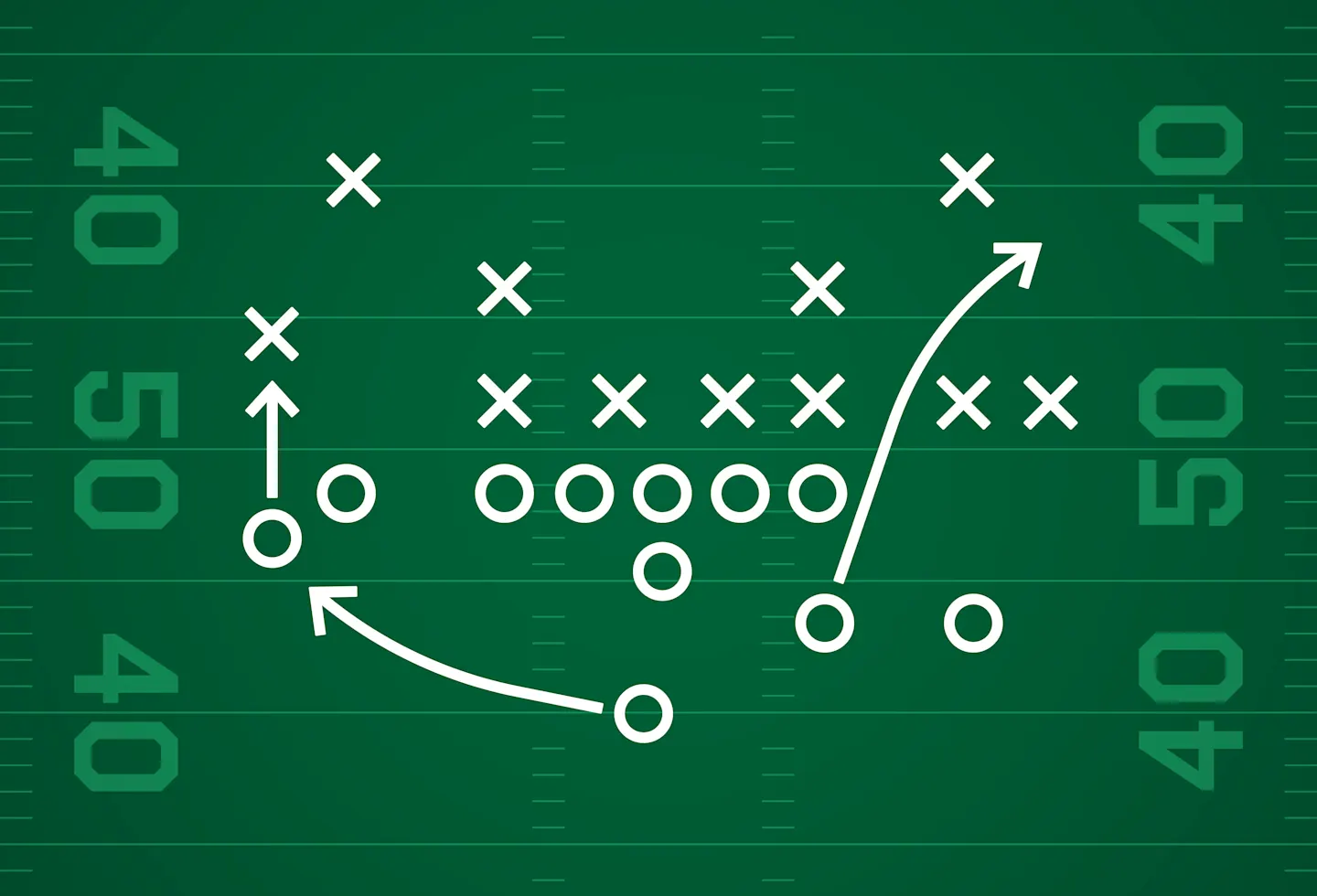
Football makes all of this visible. Eleven people line up. Everyone has an assignment. Each person’s success depends on the others doing their jobs. Then the ball is snapped and the plan meets reality.
Business is messier. The field is harder to see and the scoreboard is not always clear. But the fundamental challenge is the same.
Choose the play. Make sure everyone understands it. Then run it together.
P.S. Just like in business, stars matter — that’s management capacity and capability. It’s also likely why the Bears and the 49ers won’t win the Super Bowl again this year.
Author Information
Written by
Co-CEO and Co-Founder
Related Articles

Americans in their 20s and 30s are becoming seriously delinquent on their credit cards at a faster pace than before the pandemic and approaching levels not seen since the Great Recession.


On the surface, the premise of Buy Now, Pay Later is simple and appealing. But borrowers who can’t afford to repay their BNPL loans risk getting hit with late fees, falling behind on other financial obligations, damaging their credit and other challenges.

With financial volatility on the rise, it’s time to rethink how people use mobile apps to manage their money
Americans in their 20s and 30s are becoming seriously delinquent on their credit cards at a faster pace than before the pandemic and approaching levels not seen since the Great Recession.
On the surface, the premise of Buy Now, Pay Later is simple and appealing. But borrowers who can’t afford to repay their BNPL loans risk getting hit with late fees, falling behind on other financial obligations, damaging their credit and other challenges.
With financial volatility on the rise, it’s time to rethink how people use mobile apps to manage their money