
At Achieve, we're committed to providing you with the most accurate, relevant and helpful financial information. While some of our content may include references to products or services we offer, our editorial integrity ensures that our experts’ opinions aren’t influenced by compensation.
Achieve Insights
CEO Corner: What 'great' looks like for a CEO
Aug 17, 2026

Written by
A CISO candidate just asked me what our business would look like if the next three years were the best in history. It sent me back to the audit I run on myself every quarter: What does “great” look like for me and for our company?
TLDR: Most leaders don’t write down what great looks like, for their team, their company or for themselves. So they manage to good. Greatness is not a different set of ingredients. It is intentionality applied to the same five dimensions every company already has: people, product, capital, systems, and go to market. Whatever your team and arena, define and write down what “great” is for you and pursue that journey to greatness with intentionality. Here is the audit I run on myself and my own company.
I was recruiting our new Chief Information Security Officer when she stopped me with a better question than the one I was asking her.
"If Achieve has its most successful run over the next three years, what went right, and what does the business look like?"
I love a question that forces me to reframe my own thinking, and that one did. But notice what it asks for. It is a question about “what.” What happens, what the financials look like, what the business becomes at the end of the next phase of the journey.
So I answered her question directly. I parsed my answer on what we will look like if we succeed across several variables, including: culture, team, products, financials, valuation, her area and client impact. I also shared with her that it’s not a fixed end-state but that success for Achieve is an ongoing journey towards greatness with well defined goals.
Then I answered a different question, because the” what” has never been the hard part for me. The “how” is and that is what makes our growth durable and sustainable. How did we get there? What did the team look like along the way? Which systems were carrying the weight when the growth got heavy? I’ve always believed a successful CEO needs well defined playbooks that drive “how” you lead and “how” the team and company succeed. “What” becomes an output if you have well defined “why” and “how” coordinated for yourself and for the team.
I am a huge believer in frameworks and the best leaders at Achieve share this interest in systems and processes. It might sound lame, but I say that without embarrassment. At our current size (thousands of teammates, multiple business lines, almost a billion in revenue, genuinely complex systems) structure is not bureaucracy. It is how several thousand people stay pointed in the same direction. OKRs, weekly top threes, three year vision work, annual priorities, one pagers, ICE frameworks, DACIs, COEs, KPIs, scoreboards. Pick your alphabet. The point is that someone defined all of these and then wrote them down and defined what “great” is for each segment and process or system in our business. (Someday I will do a deeper dive on the leadership principles I actually believe in, and on how much a great Head of Strategy and Chief of Staff like Carlyn Lamia raises the ceiling on all of it.)

All of which narrows to the reflection I run on myself every quarter.
Most companies manage to good
Good is comfortable. Good hits plan. Good retains most of its people, ships most of its roadmap, and raises money when it needs to. Good is where most companies live, and where most companies meander for years without ever noticing.
In my experience as a CEO and as an advisor, the gap between good and great is not talent, luck, or market timing (although those help!) The real difference is intentionality. Great companies have defined what great looks like for each part of the business, and they manage to that definition on purpose. Good companies inherit their standards. Great companies write theirs down and share collective ownership for being great.
I do the inverse too, which I find more useful than it sounds. What do we look like in our worst form? That version is easier to write than you would expect, and that is exactly the point. Then I spend the quarter trying to deliver the best version instead. For our customers, for our teammates, for our investors, and honestly for my own sense of meaning.
Here are the five dimensions where I force the question.
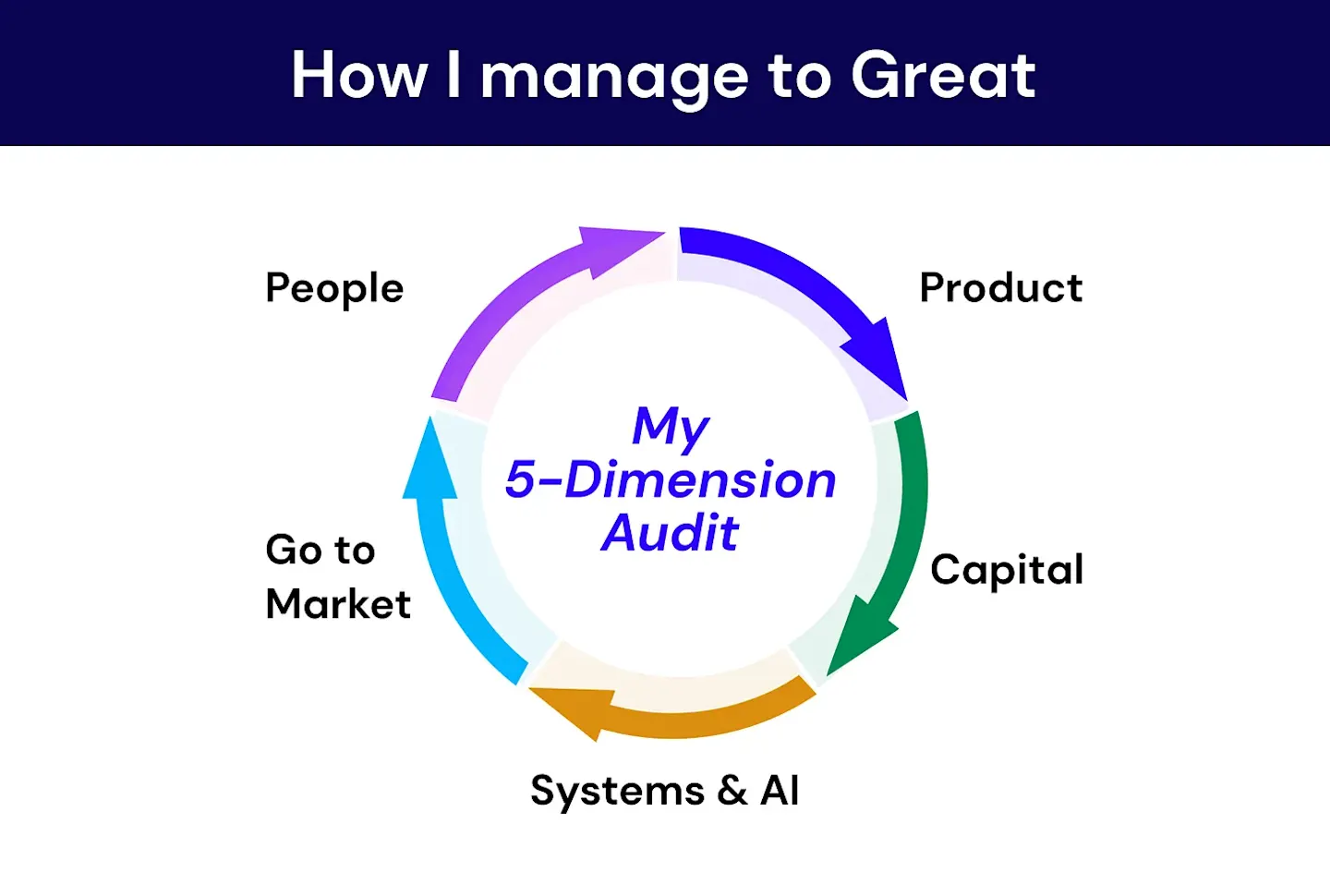
1. People: earn the ROI on an A player's time
Every A player is running a capital allocation decision, and the capital is their time and this particular phase of their career. Their prime working years. Their energy and focus. They should be asking the same question a great investor asks: where does this compound best?
Great companies earn that allocation the way they would earn an investor's capital, and they pay a return across every dimension that matters. Career growth. Financial reward. The intrinsic stuff: meaning, learning, fun, winning alongside people they respect. A players want to be challenged. They want room to take risks inside a culture with real psychological safety. They want clear objectives, so their own success and the company's success point the same way. They want an opportunity rich environment, because that is simply more fun than a fixed pie. And they want the absence of a few things too. Not a circus of constant change. Not unprofessional leadership. Not a strategy that resets every quarter so the wins never stack.
Good companies say they value their people. Great companies operationalize it. They develop talent deliberately. They elevate people before those people have to ask. They remove blockers. The difference is not the stated values. The difference is whether anyone is actually leading to them, as opposed to managing around them.
2. Product: let the customer pull you forward
There is a long running strategic debate about focus. Great companies do one thing, the argument goes, and multiproduct is a loss of discipline. The sprint and “derisking” process to get to product market fit is a real priority for any business.
Personally, I think that an overemphasis on hyper focus and narrowing the product lens gets the sequencing wrong. Single product focus is a stage, not a virtue to be celebrated.
You know you have earned product market fit when you are taking share, growth is compounding, word of mouth is spreading, and your customers start asking you for more. That last signal is the one that matters for us at Achieve. When customers pull you toward multiproduct and you stay singular, that is not discipline. That is a failure of ambition, and a failure to serve the people who asked.
No household is one size fits all. Great products in consumer finance are consultative before they are transactional: understand the customer's goals and constraints, then match them to the right solution, whether or not that solution happens to be yours.
Sometimes the right answer is not your product. A great company says so out loud, because the trust that builds is worth more than the transaction it costs.
For us, great means digital first personalization across a full product suite, meeting people where they are and walking with them toward a better financial future over a lifetime rather than a single sale. Our model helps here. In much of what we do, if the customer does not succeed, we either do not get paid or we do not keep them. That is a harder business to run. It is also the right way to think about product.
3. Capital: your capital has a personality
Most companies evaluate financing one deal at a time and one variable at a time, and that variable is usually price. Great companies run a capital roadmap that ladders to the business vision, and they understand something operators tend to learn late: capital has a personality. Duration, flexibility, structure, and the incentives of the actual humans behind the money matter as much as the rate.
I have watched founders take restrictive preferred equity with liquidity preferences and blocking rights on future raises. The capital looked cheap on the term sheet, or came with a headline valuation that felt validating at the time. It became ruinously expensive later, when it froze their operational flexibility at exactly the moment they needed to move. Cheap capital that blocks your next move is not cheap. And a board with a materially different risk tolerance than the CEO is a structural problem, not a personality problem.
I have lived both sides of this. We bootstrapped from scratch. The constraint was real. We could not invest or grow at the pace outside capital would have funded. The flexibility was real too. We kept control of our culture, our team, our strategy, our M&A decisions, and our timing, with nobody outside dictating any of it. Later, when we brought on Stone Point Capital as an equity partner, we chose alignment and not just capital. They leaned in operationally, helped us recruit, and brought real leverage on Wall Street across our securitizations and warehouse lines. Advice and relationships, well beyond the check.
Good financing wins the deal in front of you. Great financing builds a structure where duration, incentives, and the partners themselves are aligned with where the business is actually going.
4. Systems: clarity is speed
Systems and processes get dismissed as bureaucracy. I think that is exactly backwards.
When there is a single source of truth, a normalized data lake with clear definitions, clear ownership, clear decision rights, and repeatable patterns, you stop firefighting and start building. There are not four competing versions of the plan. There is not much politicking. There is a framework for what gets prioritized and a set of operating principles for how it gets executed. That stable foundation is what lets you innovate at velocity, because you are not burning your best people on rework and on the question of who does what by when.
The same logic applies to AI strategies, where the gap between good and great is now enormous. Plenty of companies “adopt” AI. Usually that means a proliferation of licenses, token usage and a thousand flowers of proofs of concept that are fun and interesting and change neither the financial characteristics of the business nor the customer experience.
Mature AI adoption is a stated, focused strategy that delivers outcomes. It shows up in margin expansion, customer experience and in natively redesigned workflows. At Achieve, our enterprise apps team is transforming into a forward-deployed, internal AI solutions team. They embed with business operators, learn the business, and rebuild workflows around native AI systems and automation in partnership with operators. Ninety percent of our code is now written with AI, which has changed the economics of every scrum team we run. We’re still figuring it out, but we have an intentional strategy. We have clear top down guiding principles around: cost efficiency, Ai driven personalization (N of one with every customer touchpoint), Ai data strategies, and cybersecurity.
The ultimate measure is the P&L: growth, conversion, customer experience, and margin. If your AI strategy is not showing up there, you might have a hobby, not an AI strategy… like all other parts of your systems and processes.
Being a firefighter is fun in brief moments, but you need systems that reliably compound to build an empire.
5. Go to market: trust compounds
What separates a great brand from a good one, especially in a category where customers often arrive stressed and skeptical?
A great brand gets sought out. And when people arrive already trusting you, they convert at higher rates, they stay longer, and they take more products over time, because the hardest part of the sale happened before the conversation started.
That is also my answer on durability. People point to scale, data, and technology as moats, and they matter. But trust compounds on top of all of them, built on a foundation of compliance and consistently good outcomes for the people you serve. Once trust is the moat, you stop competing purely on price or on the narrow specs of any single product. That is what durable actually means.
The same test applies to partnerships. We have been running this company for over two decades, and short term trades are fleeting. Aligned partners with shared incentives are the most durable structure there is. In embedded finance, that means bringing a partner a product suite their customers genuinely needed and the partner could not build alone. In servicing, it can mean freeing up cash flow for a portfolio's borrowers so they perform better and stay longer, which serves the borrower and the partner at the same time. In affinity partnerships, it means members get preferred pricing or a genuinely better experience because of where they belong.
One plus one becomes three, or it is not a great partnership.
The audit
Five dimensions. Five honest questions.
Are we earning the ROI on our best people's time, or spending it?
Are customers pulling us toward more, or are we pushing?
Does our capital have the right personality for where we are going, or are we still solving for price?
Is our AI strategy showing up in the P&L, or in a demo?
Is our moat trust that compounds, or price competition that erodes?
Good companies can answer some of these well. Great companies have written the answers down, and they manage to them every day. On purpose.
If you have never written down what great looks like for your company, that is the work. Whatever your team, your arena and field, define what great looks like across the highest leverage points for you and then march systematically toward that goal as a journey, not a destination.
Everything else is managing to good and muddling along.
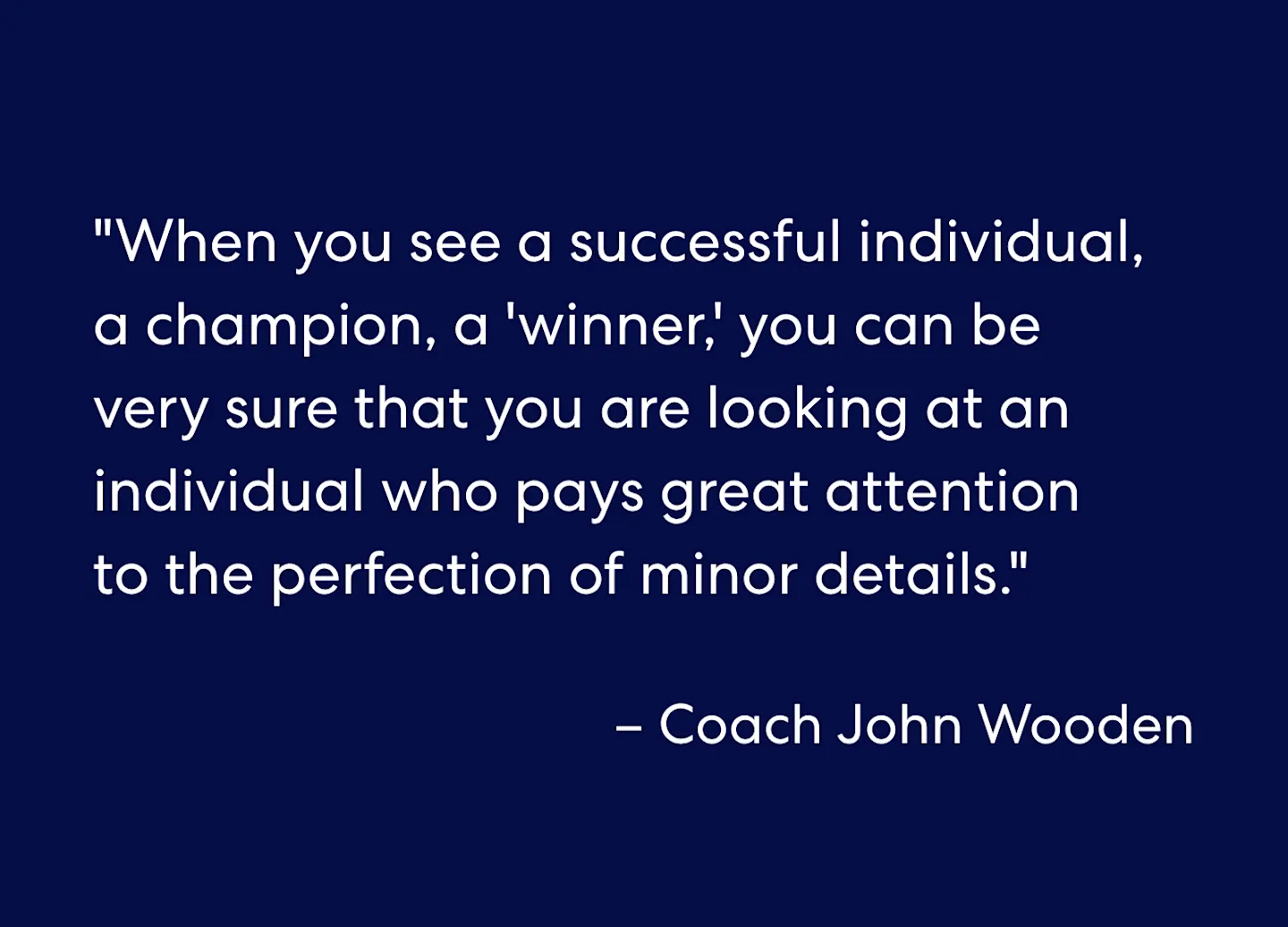
“When you see a successful individual, a champion, a "winner," you can be very sure that you are looking at an individual who pays great attention to the perfection of minor details.” —Coach John Wooden
Author Information
Written by
Co-CEO and Co-Founder
Related Articles

Americans in their 20s and 30s are becoming seriously delinquent on their credit cards at a faster pace than before the pandemic and approaching levels not seen since the Great Recession.


On the surface, the premise of Buy Now, Pay Later is simple and appealing. But borrowers who can’t afford to repay their BNPL loans risk getting hit with late fees, falling behind on other financial obligations, damaging their credit and other challenges.

With financial volatility on the rise, it’s time to rethink how people use mobile apps to manage their money
Americans in their 20s and 30s are becoming seriously delinquent on their credit cards at a faster pace than before the pandemic and approaching levels not seen since the Great Recession.
On the surface, the premise of Buy Now, Pay Later is simple and appealing. But borrowers who can’t afford to repay their BNPL loans risk getting hit with late fees, falling behind on other financial obligations, damaging their credit and other challenges.
With financial volatility on the rise, it’s time to rethink how people use mobile apps to manage their money