
At Achieve, we're committed to providing you with the most accurate, relevant and helpful financial information. While some of our content may include references to products or services we offer, our editorial integrity ensures that our experts’ opinions aren’t influenced by compensation.
Achieve Insights
Financial independence is shaping how women approach relationships
Mar 17, 2026

Written by
Women are far more likely than men to prioritize financial transparency in relationships.
Many women want financial conversations to happen earlier in relationships, and are setting clearer expectations around shared financial responsibility.
These issues are important because financial transparency is closely tied to autonomy, stability, and control over one’s future.
March is Women’s History Month, which makes it a perfect time to look at how women’s roles have evolved at work and at home, as well as in how attitudes and priorities about personal finances have changed.
For a long time, women were expected to quietly manage household finances behind the scenes. Today, they are far more likely to be making, influencing and questioning major financial decisions in their own lives and relationships. That shift may now be influencing how women approach financial conversations in relationships today, according to new survey data from Achieve.
About 58% of women say it is very important that a partner is financially transparent, compared with only 29% of men, according to Achieve’s 2026 Dating & Debt Survey. That means women are about twice as likely as men to prioritize financial transparency in a relationship.
For many women, financial compatibility may no longer be a topic reserved for later milestones like engagement or marriage. Instead, financial openness is becoming an early consideration when evaluating long-term partnership potential, particularly as short-term debt from credit cards, personal loans and buy now pay later financing becomes more common.
It’s important to remember that it wasn’t that long ago — the 1974 passing of the Equal Credit Opportunity Act (ECOA) — that women were routinely locked out of many mainstream financial products and services, including opening credit accounts in their own name to qualifying for loans without a male co-signer. To put this history into context, ECOA made credit discrimination based on gender and marital status illegal just one year before the series premiere of Saturday Night Live.
That fight for financial independence was hard won, and the recency of this history may help explain why many women take money issues in relationships so seriously. Financial transparency is not just about budgets and bills. It can also be about protecting autonomy, stability and the right to stay in control of your own future.
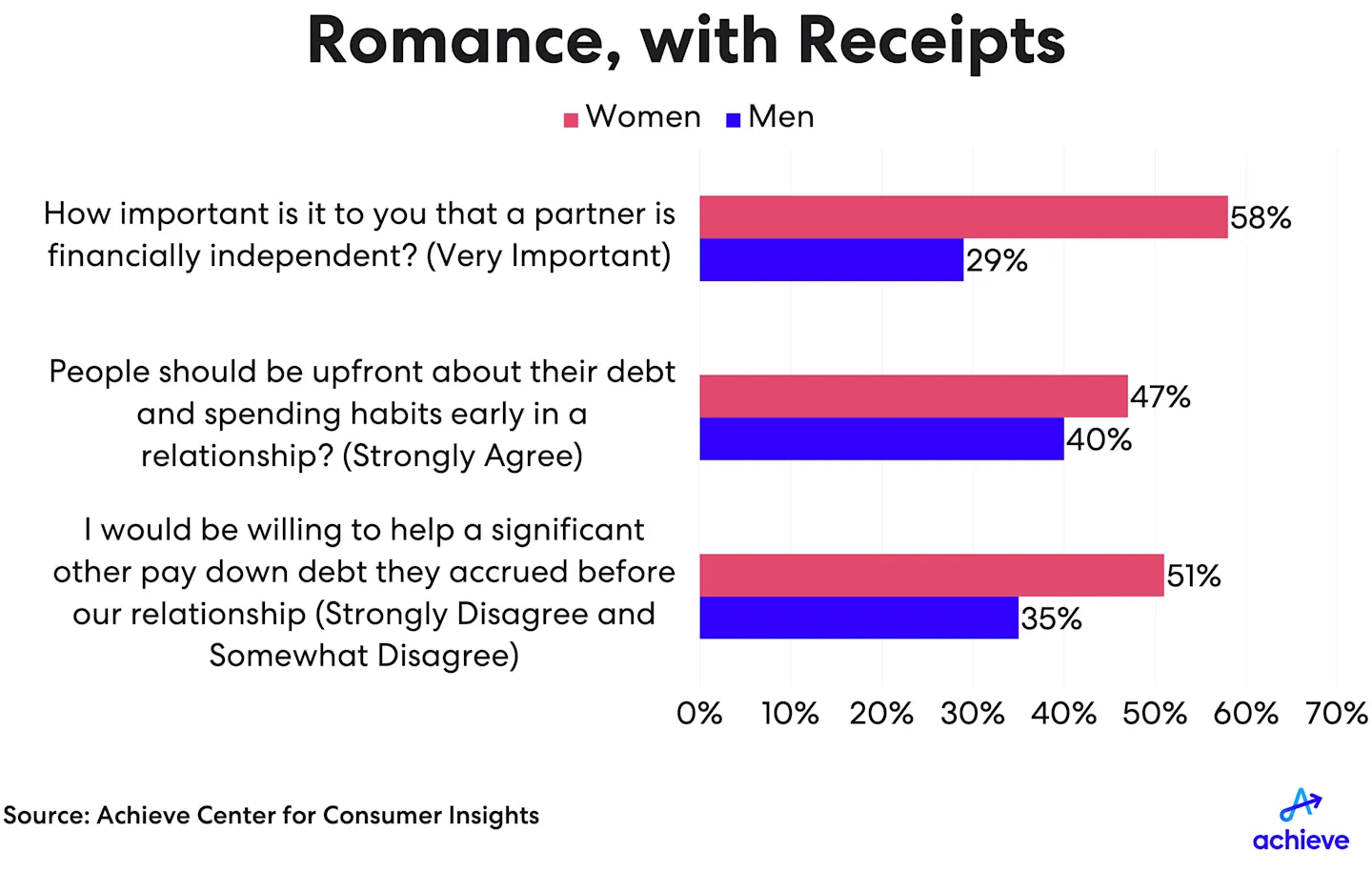
Achieve’s survey suggests that many women are not only prioritizing transparency, but also setting clearer expectations around financial responsibility early in relationships.
47% of women agree that people should be upfront about their debt and spending habits early in a relationship, compared with 40% of men.
51% of women say they would not help a significant other pay down debt accrued before the relationship, compared with 35% of men.
Taken together, the findings point to a shift in how financial expectations are being discussed in relationships. Conversations about debt may now be happening earlier as women seek greater clarity around both financial transparency and shared responsibility.
As Women’s History Month highlights the progress women have made in managing their own finances and planning for the future, those evolving financial roles may also be shaping how partnerships are defined, with transparency becoming an increasingly important foundation for shared decision-making.
Author Information
Written by
Manager, Corporate Communications
Related Articles

Americans in their 20s and 30s are becoming seriously delinquent on their credit cards at a faster pace than before the pandemic and approaching levels not seen since the Great Recession.


On the surface, the premise of Buy Now, Pay Later is simple and appealing. But borrowers who can’t afford to repay their BNPL loans risk getting hit with late fees, falling behind on other financial obligations, damaging their credit and other challenges.

With financial volatility on the rise, it’s time to rethink how people use mobile apps to manage their money
Americans in their 20s and 30s are becoming seriously delinquent on their credit cards at a faster pace than before the pandemic and approaching levels not seen since the Great Recession.
On the surface, the premise of Buy Now, Pay Later is simple and appealing. But borrowers who can’t afford to repay their BNPL loans risk getting hit with late fees, falling behind on other financial obligations, damaging their credit and other challenges.
With financial volatility on the rise, it’s time to rethink how people use mobile apps to manage their money