
At Achieve, we're committed to providing you with the most accurate, relevant and helpful financial information. While some of our content may include references to products or services we offer, our editorial integrity ensures that our experts’ opinions aren’t influenced by compensation.
Personal Loans
Personal loans for nurses: how your career could work in your favor
Updated Oct 07, 2026

Written by

Reviewed by
Key takeaways:
Personal loans for nurses aren't a special loan program—they're standard personal loans, but your job stability could help you qualify for better terms.
Lenders typically look at credit score, debt-to-income ratio, and employment verification when reviewing applications.
Nurses with lower credit scores still have options, including applying with a co-signer or working with healthcare-focused credit unions.
You can check your rate with no credit impact to find out what's available before committing.
You spend your shifts taking care of everyone else. When it comes to your own finances, you deserve options that work just as hard as you do.
If you're carrying credit card balances from nursing school you want to pay off with the help of a debt consolidation loan or bridging the gaps between travel assignments, a personal loan could help.
And here's something worth knowing: Your nursing career might actually work in your favor. Lenders look for stable income, and nursing delivers. Let's look at how personal loans work for nurses and what to consider before you apply.
What's a personal loan for nurses?
A personal loan is a lump sum of money you borrow from a bank, credit union, or online lender and repay in fixed monthly installments over a set term—typically two to five years. Most personal loans are unsecured, which means you don't need to put up your home or car as collateral. That makes them different from auto loans or mortgages, where the lender could take the asset if you stop paying.
There's no special "nurse loan" program out there. What you'll find are regular personal loans that anyone can apply for. The difference? Your profession signals stability to lenders.
The Bureau of Labor Statistics projects registered nurse jobs will grow faster than the average occupation, with about 194,700 openings a year through 2035. Lenders notice that kind of job security.
Since lenders are trying to assess whether you'll repay the loan, a career in a high-demand field could work in your favor when it comes to approval odds and the rates you're offered.
Common reasons nurses use personal loans
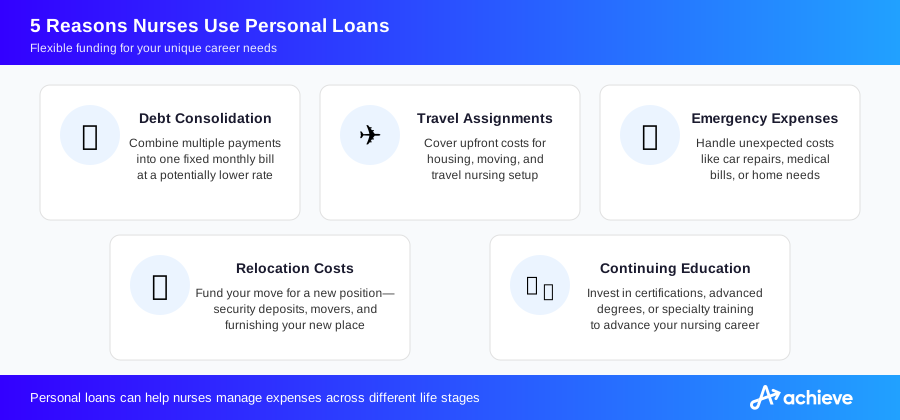
Debt consolidation. If you're juggling credit cards, student loans, and maybe a medical bill or two, a personal loan could let you combine them into one payment—ideally at a lower interest rate. That means one payment, one due date, and less mental energy spent tracking multiple accounts each month.
Gaps between travel assignments. Your contract in Phoenix ends, and the next one in Seattle starts in six weeks. That's six weeks of rent, groceries, and life with no paycheck coming in. A personal loan could cover the gap until your next assignment begins. And the fixed monthly payment could make it easier to budget around once you're working again.
Emergencies. Your car's transmission goes out. Your dog needs surgery. These situations don't wait for your next payday. A personal loan could get money in your hands fast—sometimes within a few business days. This matters when you're dealing with something urgent.
Relocation. Moving for a new job can be common for some nurses. New hospital, new city. Between security deposits, movers, and setting up a new place, the costs add up quickly. A loan could smooth the transition while you wait for that first paycheck.
Continuing education. If you want to become a nurse practitioner or need a specialty certification, borrowing to invest in training could boost your earning potential down the road. Since the repayment is structured over a set term, you'll know exactly what you're paying each month while you're completing your program.
How to qualify for a personal loan as a nurse
Lenders look at a few key factors when reviewing your application.
Credit score. Most lenders prefer a credit score of 670 or higher for the best rates. That said, some lenders work with borrowers in the "fair" credit range, which Experian defines as scores of 580 to 669.
Debt-to-income ratio (DTI). This is your total monthly debt payments plus housing costs divided by your gross monthly income. Many lenders prefer a DTI of 36% or lower, though some may approve borrowers with higher ratios depending on other factors. If your DTI is on the higher side, it could affect the rates you're offered or whether you're approved at all, so it's worth calculating yours before you apply.
Employment verification. Here's where nurses often have an advantage. Lenders want stable income, and nursing delivers. Have your recent pay stubs ready. If you're a travel nurse, you may also need an employment verification letter from your staffing agency confirming your assignment details.
For variable or PRN income, gather recent pay stubs and one to two years of tax returns. Those documents show a lender a steady earnings pattern. If you travel and move often, be ready to explain that frequent address changes are work-driven. Provide prior addresses and your staffing agency assignment details if asked.
Documents you'll typically need to apply:
Government-issued ID (driver's license or passport)
Recent pay stubs or W-2 forms
Tax returns (one to two years)
Bank statements
Employment verification letter (especially for travel nurses or per diem workers)
Personal loan options for nurses with bad credit
A lower credit score doesn't mean no. It means fewer options—but options still exist.
If you've been denied before or you're worried about your credit, here are some paths forward:
Consider a co-signer. If someone with solid credit is willing to apply with you as a co-signer, it could improve your approval odds and help you qualify for a better rate. The trade-off: They're equally responsible for the loan if you can't pay. That's a significant commitment, so make sure you both understand what's involved before moving forward.
Look into credit unions. Specifically, consider healthcare-specific credit unions. Several credit unions serve only healthcare workers and may offer rate discounts, more flexible underwriting, and lower fees compared to traditional banks.
Check prequalification offers. Many lenders let you use prequalification to get estimated rates with a soft credit pull—no commitment, no impact on your credit score. Comparing a few offers before formally applying gives you a clearer picture of what's realistic.
Give it time if you can. If your situation isn't urgent, a few months of paying down balances, disputing credit report errors, and avoiding new credit applications could help improve your score and your options.
Achieve is not a Credit Repair Organization and does not provide, or offer, services or advice to repair, modify, or improve your credit.
What to look for in a personal loan
Not all loans are created equal. Here's how to compare offers and find the right fit.
APR (annual percentage rate). This is the true cost of borrowing. It includes the interest rate plus most lender fees. Personal loan APRs typically range from around 8% to 36%, depending on your credit profile and the lender. Since APR accounts for fees that the interest rate alone doesn't capture, it's the better number to use when comparing offers side by side.
Loan term. Most personal loans offer terms between two and five years. A shorter term means higher monthly payments but less interest paid overall. A longer term lowers your monthly payment but typically costs more in the long run. The right choice depends on your budget and how quickly you want to get rid of the debt.
Origination fee. Some lenders charge an upfront fee (typically 1% to 10% of the loan amount) that's deducted from your loan proceeds. Others charge nothing. If you're borrowing $10,000 and the fee is 5%, you'd receive $9,500 but owe the full $10,000. Factor this into your total cost when comparing.
Prepayment penalty. Can you pay off the loan early without a fee? Most personal loans don't have prepayment penalties, but it's worth confirming before you sign.
Funding speed. If you need money fast, look for lenders that offer funding within one to three business days after approval.
What to compare | What to look for |
APR | Lower is better: compare across lenders |
Term | 2 to 5 years typical; balance payment vs. total cost |
Origination fee | 0% to 10%; some lenders charge nothing |
Prepayment penalty | Ideally none |
Funding speed | 1 to 3 business days if urgent |
Alternatives to personal loans
A personal loan isn't the only path. Depending on your situation, one of these might fit better:
Nurse loan forgiveness programs. If you have federal student loans and work in an underserved area, the Nurse Corps Loan Repayment Program could forgive up to 85% of your unpaid nursing education debt. Public Service Loan Forgiveness (PSLF) may also apply if you work for a qualifying nonprofit or government employer. These programs cover student loans, not personal loans—but they could free up your budget for other expenses.
0% APR credit cards. If your credit is strong, a balance transfer card with a 0% introductory APR could let you pay down debt interest-free for a promotional period (often 12 to 21 months), minus a balance transfer fee. The key is paying it off before the promo ends. Otherwise you could face a high regular APR on whatever balance remains.
Home equity options. If you own a home, a home equity loan or HELOC may offer lower rates than a personal loan. The trade-off: Your home serves as collateral, which means you could lose it if you can't repay the loan.
Employer assistance programs. Some hospitals and healthcare systems offer emergency funds, tuition reimbursement, or employee loan programs. Ask HR what's available. You might be surprised.
What's next
If you're thinking about a personal loan, a few steps can help you figure out where you stand:
Check your credit score. Many banks and credit card apps show it for free. Knowing your score helps give you a realistic sense of what rates you might qualify for.
Calculate your DTI. Divide your monthly debt payments (including housing) by your gross monthly income. If your ratio is above 36%, paying down some balances before applying could improve your options.
Gather your documents. Start compiling pay stubs, your ID, tax returns, and bank statements. Having everything ready speeds up the application process once you decide to move forward.
Get prequalified. Find out potential rates from multiple lenders that use a soft credit inquiry that won't affect your credit score.
Check your estimated rate through Achieve Personal Loans—it takes just a few minutes and there's no obligation.
Author Information
Written by
Kimberly is Achieve’s senior editor. She is a financial counselor accredited by the Association for Financial Counseling & Planning Education®, and a mortgage expert for The Motley Fool. She owns and manages a 350-writer content agency.
Reviewed by
Kailey is a CERTIFIED FINANCIAL PLANNER® Professional and has been writing about finance, including credit cards, banking, insurance, and retirement, since 2013. Her advice has been featured in major publications, including The Motley Fool.
Frequently asked questions about personal loans for nurses
Yes, some lenders offer no-credit-check loans to nurses. But they may not be the magic solution you're hoping for. No-credit-check loans typically carry very high costs, fees, and rates.
A steadier path is to prequalify with a soft inquiry to estimate your rates with a few different lenders. A soft inquiry doesn't impact your credit score. A co-signer with strong credit could also help you qualify for better terms.
Yes, some lenders work with borrowers who have fair or poor credit, though interest rates may be higher. A co-signer with strong credit could improve your chances. Healthcare-focused credit unions may also offer more flexible options. Prequalification offers that use a soft credit inquiry let you compare rates without affecting your score.
Many personal loans are available to nurses with a variety of credit scores. Many lenders prefer scores of 670 or higher for the best rates, but some work with borrowers in the fair range, which Experian defines as scores of 580 to 669. A prequalification using a soft credit check lets you estimate what you could qualify for without impacting your credit score.
Related Articles

Adding a co-signer to a personal loan application could improve your approval odds and rate. Learn what lenders look for and how to apply with Achieve.


Learn how unsecured personal loans work, compare rates and terms to credit cards, and find out how to qualify — even with fair credit. Apply today.

Learn how to pay off credit card debt with a personal loan. Compare rates, lower your monthly payments, and get a plan to become debt-free faster.

Adding a co-signer to a personal loan application could improve your approval odds and rate. Learn what lenders look for and how to apply with Achieve.
Learn how unsecured personal loans work, compare rates and terms to credit cards, and find out how to qualify — even with fair credit. Apply today.
Learn how to pay off credit card debt with a personal loan. Compare rates, lower your monthly payments, and get a plan to become debt-free faster.